 The Starset Society
by:Rhodilee Jean A. Dolor
A California-based startup is eyeing to use an inflatable bag to catch asteroids and clean up garbage in space.
TransAstra, a company founded by an aerospace engineer who taught at Caltech, has developed and tested a space bag designed to catch anything from small rocks to house-sized boulders.
The device called Capture Bag comes in different sizes and can be used to address challenges involved in extracting resources from asteroids. It also holds potential in alleviating the growing problem of space junk that threatens spacecraft and astronauts in orbit.
Asteroid Mining
Asteroids hold large quantities of precious and common metals, which makes them a rich source of much needed resources on Earth.
The metal-rich asteroid 16 Psyche, the target of a NASA mission launched in October 2023, has an estimated monetary value of $100,000 quadrillion. Scientists say the celestial body is a goldmine because it is packed with rare elements such as platinum and palladium that are needed in cars and electronics.
Asteroid mining could serve as a sustainable alternative to Earth-based mineral extraction amid issues such as declining supplies and damage to the environment.
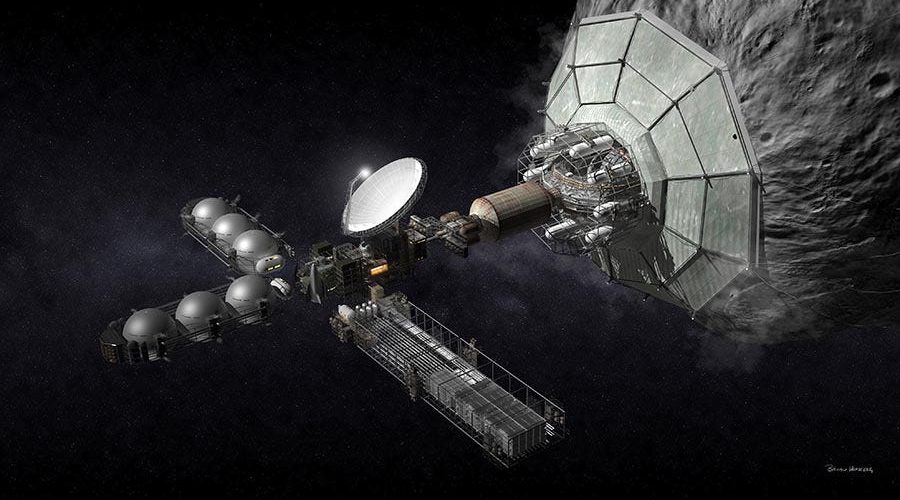
TransAstra’s idea for mining resources from space rocks involves a system that can identify the asteroid to be mined, capture it and move it to a safe location in space where it will be processed to extract minerals.
“Asteroid mining is a very risky, challenging thing to do,” says TransAstra founder Joel Sercel, according to CNN. “To solve the asteroid mining problem, you actually have to solve four other problems that we call detect, capture, move and process.”
Potential Mining Targets
Sercel says he knows where to find asteroids worth mining. He is particularly interested in a special population of bodies in highly Earth-like orbits looping the sun.
He says these objects drift very slowly by our planet and are just a few billion kilometers away.
“We already know where hundreds of these objects are, and we’re planning on going and getting the first one in 2028 — that, we think, will foment a true industrial revolution in space,” says Sercel.
TransAstra already deployed a dozen telescopes in Arizona, California and Australia as part of a telescope network known as Sutter to look for asteroids that are suitable for mining. The company is also planning to set up an additional location in Spain.
The startup wants to use its space bag to catch an asteroid that has been profiled as suitable for mining.
Cleaning Up Space Junk
The Capture Bag may also help address the growing problem of man-made space debris traveling in low Earth orbit.
Space junks such as old satellites and rocket parts threaten to damage the International Space Station (ISS) and endanger astronauts traveling to and from the orbiting laboratory.
China recently postponed the return of three of its astronauts from a space mission after a piece of space junk struck the Shenzhou 20 spacecraft that was intended to transport them back to Earth from the Tiangong space station.
Scientists anticipate the problem with orbital debris to worsen in the coming years as nations and private firms launch space missions.
“We really need to get hold of this problem to keep space safely navigable,” Sercel says. “Given the growth of traffic in low Earth orbit, within the next 10 years, we will see tens of thousands of objects there.”
TransAstra says the bag can help clean up space junk. The device can re-open after catching a target allowing it to capture multiple pieces of debris in one flight.
The collected objects can then be moved away from common operational orbit to a graveyard orbit where some satellites are taken at the end of their life to reduce the risk of colliding with operational spacecraft.
Alternatively, the captured items may be brought to an in-orbit repurposing station where they can be turned into something useful.
The Capture Bag
The leak-proof object is made of materials used in aerospace applications such as kevlar and aluminum. The bag can be mounted on a carrier vehicle that will release it near the target space rock. Once deployed, the bag will inflate to make room for the object.
The bag comes in six sizes from micro, which could fit in a coffee cup and can capture small debris the size of water melon.
TransAstra sent the next size measuring a meter in diameter to the ISS in October where it was tested and found working in microgravity and vacuum. “The beauty of this technology is that we can pretty much capture anything that fits into the bag, whether that is an asteroid or a satellite,” says TransAstra chief engineer Thibaud Talon. “The system is designed around an inflatable, pressurized structure. Gravity plays a big role in how the bag behaves, so it is critical to demonstrate how it works in actual microgravity.”
The company is currently working on the large size version of the bag, which measures 10 meters. Sercel says the engineering will likely be completed in over a year after which the bag will be ready for space flight.
The largest proposed Capture Bag would be big enough to fit a 10,000-ton asteroid the size of a small building. “That 10-meter capture bag will be big enough to find satellites that are in graveyard orbits but might be causing navigational issues. It will capture them and move them to a safer place. That’s an important mission,” Sercel says. “But it’s also big enough to go out and get asteroids, so we are currently working with industrial partners on a plan to get an asteroid that might be 100 tons.”
Sercel says the Capture Bag is relatively inexpensive. The scientist says each of these space bags will initially cost millions of dollars but the cost will eventually drop.