 The Starset Society
Researchers from the Natural History Museum have uncovered the specific conditions needed to support the formation of a special but rare mineral that can help address the increasing power demands of modern-day technologies.
Strikingly Similar to the Fictional Kryptonite
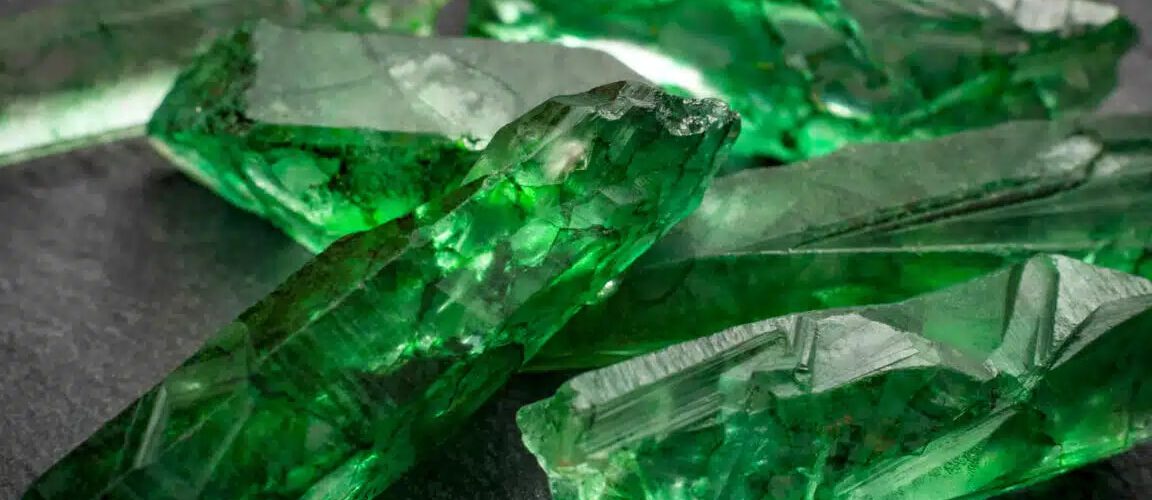
Jadarite is a rare lithium-bearing mineral with a chemical formula that is strikingly similar to that of kryptonite, the fictional crystalline material in Superman that can weaken the comic book superhero.
The 2006 film Superman Returns described the composition of the kryptonite as sodium lithium boron silicate hydroxide with fluorine.
Following the discovery of jadarite by researchers from the mining giant Rio Tinto in 2004, scientists who studied the mineral were surprised to find out that its chemical makeup is eerily similar to that of the kryptonite.
“Towards the end of my research I searched the web using the mineral’s chemical formula – sodium lithium boron silicate hydroxide – and was amazed to discover that same scientific name, written on a case of rock containing kryptonite stolen by Lex Luthor from a museum in the film Superman Returns,” Chris Stanley, a mineralogist at London’s Natural History Museum, told BBC News in 2007.
“The new mineral does not contain fluorine (which it does in the film) and is white rather than green but, in all other respects, the chemistry matches that for the rock containing kryptonite.”
Jadarite has a high concentration of lithium and boron, elements that are relatively rare and serve critical industrial uses. Lithium is a core component in rechargeable lithium-ion batteries that power portable devices and electric vehicles, while boron is used in heat-resistant smartphone glasses, solar panels and wind turbine materials.
Jadarite has a high concentration of lithium and boron, elements that are relatively rare and serve critical industrial uses. Lithium is a core component in rechargeable lithium-ion batteries that power portable devices and electric vehicles (EVs), while boron is used in heat-resistant smartphone glass, solar panels and wind turbine materials.
White Gold
Lithium is also called “white gold” because of its economic value and silver color. The material is a crucial ingredient in batteries used by electronic devices. and EVs.
The need for lithium is anticipated to grow in the coming years as demand from the energy storage sector and electric vehicles—which already account for the significant portion of total global car sales—continue to rise.
Market predictions project that EVs will make up over half of new passenger car sales in the US by 2030. To date, the price of lithium batteries accounts for 40% of the production costs of these vehicles.
Compared with other lithium sources such as the spodumene, a proven source material for battery production, jadarite requires less energy to extract lithium from it, but the mineral has only been found in one place on Earth— the Jadar Basin in Serbia.
Jardanite Recipe
Francesco Putzolu, a scientist at the Natural History Museum, and colleagues now report that they have discovered why the white, nodular mineral is rare.
In their study published in the journal Nature Geoscience on June 11, the researchers found that jadarite needs to follow an exact set of geological steps in highly specific conditions in order to form.
The process involves a strict interplay between alkaline-rich terminal lakes, lithium-rich volcanic glass and the transformation of clay minerals into exceptionally rare crystalline structures.
According to Putzolu, the recipe is so precise that scientists have not yet seen the formation of jadarite replicated anywhere else on Earth.
“Similar to baking a cake, everything needs to be measured and exact for this rare mineral to form. For instance, if the mineral ingredients are not just right, if the conditions are too acidic or too cold, jadarite will not form,” he said.
Study co-author Robin Armstrong, a geologist at the Natural History Museum, pointed out the massive potential of jadarite in addressing the rising need for lithium.
“As the demand for lithium continues in the race toward renewable energy, if mined, jadarite can offer huge potential,” Armstrong said. “This process brings us closer to identifying other possible deposits by unravelling the formation conditions in the lab.”
Jadar Lithium Project
Although found only in one location on Earth, the mineral was found in massive quantities that, when mined, could produce enough lithium to power up to 90% of Europe’s quota of electric cars.
According to Rio Tinto, its proposed Jadar project in Serbia would produce approximately 58,000 tons of lithium carbonate each year in full operation. The company says this would equate to 1.1 million cars, or 17% of electric vehicle production in Europe.
The projected production over the expected mine life of 40 years is 2.3 million tons of lithium carbonate.
“A vital component for clean technologies such as electric vehicles and battery storage, lithium will play an essential role in the transition to a low carbon economy,” reads the Rio Tinto website. “The scale and high-grade nature of the Jadar deposit provides the potential for a mine to supply lithium products into the electric vehicle value chain for decades, positioning Serbia as the European hub for green energy. Double digit demand growth is forecast for lithium over the next decade.”
Serbian President Aleksandar Vucic has described the jadarite mining project as a potential game-changer for the country and even the entire region. Officials also said that it could boost the economy, but in 2022, the government suspended the project following weeks of protests by opponents who warned that the mine could contaminate land and water in the area.
Last year, Vucic said that mining could start as early as 2028 after the European Union and Rio Tinto gave new guarantees on compliance and environmental standards.
Rio Tinto, which would become one of the world’s top ten leading lithium manufacturers if the plan pushes through, has denounced what it says are unsubstantiated claims that the mining project would damage water resources, soil, biodiversity and air quality and pose risk to human health.