 The Starset Society
How Technology has potential to Revolutionize the World’s Diet
By A’liya Spinner
How the Sausage is Made
A huge factory sits in the shadow of the Amazon rainforest. The air is filled with the sweet smell of pollen and the calls of brightly-plumaged birds, alighting on the roof to look curiously at the endless stream of trucks and people coming and going. Only fifteen years prior, this massive building was surrounded by nothing but cleared pastures, yellowing in the dry season and empty of life. Now, the rainforest has come creeping back, acre by acre, bringing lianas and undergrowth and insects to this fallow land. The trees are young, but they will thicken and grow tall under the new stewardship of this hulking factory, that stalwart guardian of the forest.
But where are the cattle that roamed by the tens of thousands over these pampas now reclaimed by the Amazon? Here, a handful remain, grazing contentedly in the land that has been reserved for them. They bear some resemblance to their ancestors, but they’re sturdier, healthier, with bright eyes and a playful nature. These cattle were bred for longevity, not slaughter; once a week, a veterinarian thoroughly examines them, inside and out, for diseases or parasites. They are groomed regularly; even their teeth are checked for decay. Like champion racehorses, each individual is pedigreed, and their bloodlines are mixed with other herds around the world. Unlike the livestock of the past, these animals are valued for their lives— not their deaths.
That evening, the herd meanders toward the factory, which opens grand barn doors along its flank to welcome them. They rest peacefully in familiar stalls, and while they do, the work begins. Guided by expert hands, a machine performs a small biopsy on each animal, drawing out a single vial of tissue. It then pneumatically whisks them away to the great depths of this factory, where they are laid out on a bed of nutrients and begin to duplicate and grow. It doubles in size, triples, quadruples and then quadruples again, until it can expand no further in its container. These colonies are cultivated side by side, and every few hours, another machine excises pieces from the regenerating mass.
Finally, these freshly-divided pieces are brought to the factory’s internal vats, its priceless heart. A web of biomolecules awaits, strung together by amino acids and poised as a scaffold, almost invisible to the naked eye. Here, drip-fed a cocktail of molecules and building blocks, the cells take on a new, more familiar shape. Layer by layer, the muscle grows, a perfect duplicate to the one found inside the sleeping cow. From that one vial, drawn from the animal while it slept, a thousand muscles are grown on the factory floor, which thrums with the song of spotless machinery.
The birds announce the arrival of dawn, loudly squabbling amongst themselves in the forest’s edge just beyond civilization. Trucks again begin to arrive, and onto them are loaded perfectly cut and packaged meats. Everything that cleared pampas of cattle once produced is now made in this hulking factory, and the land has been given again to the wild. Peccaries wander out of the underbrush, snuffling through the early morning dew. Huge, black bees flutter about, visiting flowers planted on the side of the road. The factory’s gates are opened, and the cattle wander free and alive as their meat leaves by the truckload to feed people around the world.
Meat Of All Kinds
Artificial meat is no new concept. “Veggie burgers” made of black beans or wheat, Beyond Meat made of rice, starch, and peas, or dishes made of tofu (condensed soy) are popular alternatives for the meat of animals enjoyed around the world. The trend of completely “plant-based” diets is also on the rise. In 2020, 8% of global protein-food sales were vegan alternatives to meat and dairy, with some experts predicting that demand to increase fivefold by 2030. Meal delivery services specializing in plant-based diets and an increasing corporate push to include meat-alternatives on the shelves have also made the diet more accessible to the average consumer.
While people turn to plant-based foods for a plethora of reasons, including personal health, taste, and price, the overwhelming push toward veganism is due to ethical and sustainability concerns with the modern meat industry. The livestock industry accounts for roughly 20% of global carbon emissions, and of that number, beef alone contributes an astounding 40%. Aside from its carbon footprint, the meat industry is infamous for its cruelty and poor living conditions for animals; the severity of these conditions were recently brought into the limelight as cramped, disease-ridden factory farms contributed to a massive outbreak of avian influenza. Cattle ranching is also the number one cause of deforestation around the world, but especially of the Amazon Rainforest, which is being cleared at an alarming rate to create space for beef production in South America. Of course, meat production in itself is not inherently evil or unsustainable— local farms and committed farmers take steps to mitigate carbon emissions, treat their animals ethically, and work within existing land. Still, the majority of “real meat” that we consume comes from unsustainable sources.
Real Meat — But Not From An Animal?
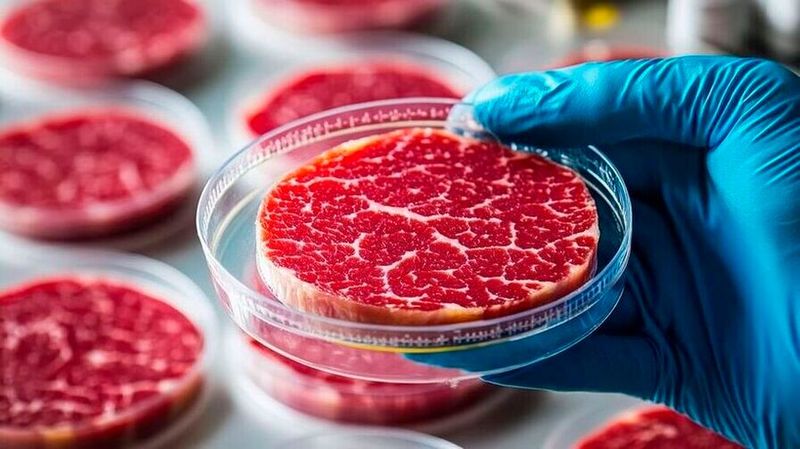
So, what precisely is “lab-grown” meat? In many ways, it’s exactly what it sounds like: animal meat that is produced in a lab. Also called “cultured” or “cultivated” meat, this meat is grown from animal cells. Somewhat similar to fermenting grain for beer, meat cultures take high-quality cells from livestock and select those capable of multiplying to cultivate. Cultures are kept in controlled environments and supplied with nutrients to simulate growth inside an animal’s body. An artificial scaffold made of biomolecules is created to guide the muscle fibers during development, creating a lifelike structure and texture. Alternatively, cuts of meat can be “3D printed”, layer by layer, using different “bioinks” to achieve the desired shape.
Once a culture has grown to maturity, it is “harvested” and processed just like conventional meat before being packaged for sale. Although it may sound strange and futuristic, both Singapore and the United States have already approved the sale of “vat-grown” chicken meat. Although this meat is currently being made in small quantities and only sold to select restaurants, it has proven that laboratory-grown protein can be safely made and consumed.
The cells required to grow cultures are obtained without killing the animal, and so a single animal can produce practically infinite starting cells for cultivation over the course of its life without having to be slaughtered. Thus, lab-meat “farms” would only need to keep a handful of the highest quality, well cared-for animals to provide desirable strains for their lab cultures. Furthermore, because their product is originally sourced from an animal and “fed” the same nutrients the animal would receive, the resulting protein is, ideally, identical to meat from traditional livestock. This identical taste, texture, and nutrition makes lab-grown meat a more appealing alternative for those who won’t or can’t eat plant-based proteins.
Yet, maybe ‘identical’ is not the goal. Because cultures are grown in highly-controlled laboratory environments, they are easier than living animals to bioengineer. Lab meat could be grown to contain lower cholesterol and fats, or even healthier varieties of these molecules, like the omega-3 fats typically found in fish. Those who refuse animal products (particularly red meat) for health reasons could enjoy them once again. This genetic manipulation could even be further used to greatly speed the growth rate of cultures, putting fresh meat on the market faster and increasing output without continuously expanding or building facilities. For those against animal farming altogether, there exists a hope that genetic engineering can someday create “immortal cell lines” that can be indefinitely cultivated without the need for new samples from live animals. However, some experts have voiced concern that tampering with the growth rate or genetic make-up of meat in the lab can lead to unhealthy side effects, such as tumors or other carcinogenic mutations. Extensive testing will be required to ensure that altered cultures are not only safe for consumers but also retain their authentic taste, and engineered strains will probably not become available until long after “traditional” lab-meat has entered the market.Lab-grown meat doesn’t need to be altered in any way to be potentially healthier, not only for human consumption, but for living livestock as well. For example, “bovine cysticercosis”— an infection of larval tapeworms in cows that creates pupal cysts in the muscle— can be entirely prevented by cultivating beef in a lab. Bovine cysticercosis is typically only discovered after an animal is slaughtered; if the meat is considered too infested, it is destroyed, wasting the animal’s life. Meat with only a few cysts is still considered safe for human consumption, and proper cooking is typically sufficient to kill the tapeworm. But eating undercooked or raw beef can transfer the tapeworm to human or canine hosts, where they develop into harmful parasitic adult forms. While we may think we thoroughly cook all of our meals, even the innocuous act of feeding our pets scraps of infected muscle tissue can cause tapeworms to develop, and their feces can then transfer that infection to owners. Meat grown in asterile laboratory environment runs no such risk of developing cysts: farmed cattle ingest the eggs while grazing, while cultivated beef is “fed” nutrients directly.
Cultured meat will also hopefully lead to fewer factory farms and less rampant suffering and disease in the livestock industry. “Hybrid” facilities, built on existing farms, can combine factors that grow meat cultures with smaller live-animal operations. Healthy, well-cared for animals produce healthier cells for cultivation. Smaller herds also allow for intentional and restorative breeding. Modern livestock herds have been so selectively bred for milk production, rapid growth, and high meat production that herds suffer inbreeding depression from low genetic diversity, and are typically short-lived and face numerous health issues. With restorative breeding, diverse bloodlines can be cultivated, cared-for, and enjoyed by more consumers. Especially because different breeds of cattle have different tastes and sensory qualities, one facility can keep a handful of individuals from an array of breeds and produce equivalent or even more varieties of meat than huge cattle ranches. Smaller herds (or flocks) with adequate individual care will also curb outbreaks of avian influenza and other zoonotic diseases, which spread through and wipe out huge numbers of factory farmed animals while mutating into more dangerous forms that threaten both human and wild populations. Lab-grown meat, therefore, may not only reduce the amount of animals killed for food, but the amount of animals culled from herds for disease and infection whose lives were wasted.
Obstacles and Innovations
The largest obstacle facing the integration of cultured meat in the market is legislation banning the research and creation of laboratory cultures. Already in the US, seven states have banned the production or sale of any lab-grown meat products, typically claiming that the sale of such products could potentially mislead consumers. However, many lawmakers— such as Governor Jim Pillen of Nebraska, who is also the founder of Nebaskra’s largest pork farm— have personal connections to or receive large campaign donations from the livestock industry. After Texas’ ban on lab-cultivated meat, Texas Agriculture Commissioner Sid Miller said, “Texans have a God-given right to know what’s on their plate, […] It’s plain cowboy logic that we must safeguard our real, authentic meat industry from synthetic alternatives”, further suggesting that concern for misinformed customers is behind the ban. This is despite the fact that legislation simply requiring lab-grown foods to be clearly labeled is not nearly so popular. Behind the scenes, it is most likely that the livestock industry is attempting to sabotage the success of laboratory meat to prevent competition, robbing the public of the choice to support more climate-friendly and humane sources of meat. Those who have valid concerns about the health impacts of eating cultured meat should encourage continued exploration and testing of this product, rather than banning it outright. Beyond political hurdles, laboratory meat still has several obstacles to overcome before large-scale production becomes possible. For example, current methods of cultivating cell cultures are almost as energetically costly and carbon-emitting as raising livestock. The process requires refinement and new technological innovations in cell-scaffolding procedures, as well as low-cost sources of amino acids, new global supply chains for necessary biomolecules, and larger-scale bioreactors than currently exist. This will require investment in research and the construction of new facilities, delaying availability to the public for several more years. Then there are the challenges of public acceptance: will consumers be willing to experiment with “synthetic” meat? What will it cost when it finally appears on shelves? If lab-grown meat becomes an expensive, “prestige” food, it will not sell enough to undercut the demand for cheap protein that incentivises factory farming.
Many technologies are expensive, inefficient, or slow when first created. However, with innovation and progress, animal-free meat may someday become a dietary staple, and sprawling, empty pastures will be restored to the wild ecosystems they replaced. There may even come a time when “meat printing” technology is so refined and efficient it becomes a household item, similar in function to a breadmaker or traditional 3D printer. Bioinks to create the desired species and cut of meat could be purchased and then grown and harvested conveniently at home, which is frankly as fresh as it could possibly be. But even if lab meat cultivation never gets quite so domestic, there is no doubt that these innovations could change the way the world treats livestock, protein, and land use— all for the better.