 The Starset Society
New theoretical models have strengthened the case that immense, energy-harvesting structures orbiting their host stars could exist in principle in distant stellar systems. With the right engineering precautions, calculations published in Monthly Notices of the Royal Astronomical Society, carried out by Colin McInnes at the University of Glasgow, show that both stellar engines and Dyson bubbles can become gravitationally stable, allowing them to tap into the vast amounts of energy emitted by their host stars.
Why astronomers imagine mega-structures
For decades, astronomers have pondered the possibility of alien civilizations far more technologically advanced than our own. While these studies remain entirely speculative, many have converged on similar ideas for harvesting stellar energy: envisioning vast structures deployed around host stars.
If such structures could exist, they would provide civilizations with vastly more energy than any planet could offer—enough for ventures ranging from the terraforming of new worlds, to interstellar journeys spanning many generations.
Among the structures considered in previous studies are stellar engines: immense reflecting disks gravitationally coupled to their host stars, which use the momentum imparted by starlight to generate thrust. In principle, these devices could accelerate the star and everything orbiting it in a chosen direction, effectively turning an entire star system into a colossal spacecraft.
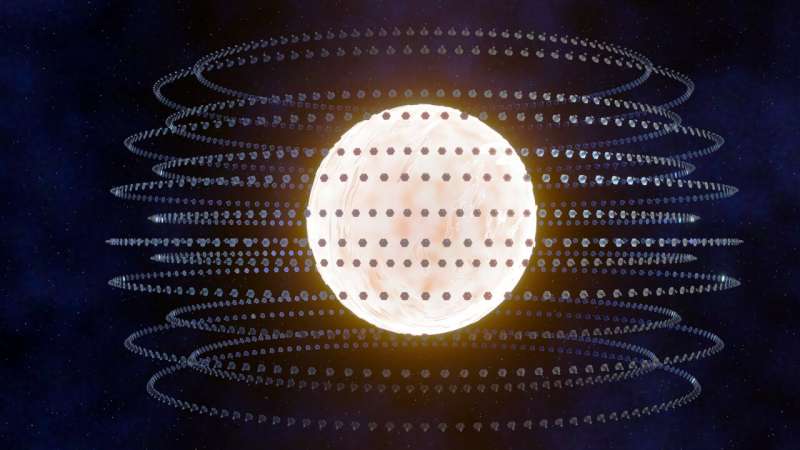
Alternatively, Dyson bubbles are static swarms of smaller light reflectors that may encircle the star, allowing them to collect a substantial portion of the energy they emit.
The long-term stability problem
Despite decades of theoretical work, these concepts face a fundamental question: could such ultra-large structures really survive on cosmic scales without constant active maintenance?
“The idea of ultra-large artificial structures, such as stellar engines and Dyson bubbles around stars, has been discussed in SETI studies for some time,” McInnes explains. “My interest is in using mathematical models to try to understand their dynamics, and in particular how they could be configured to be passively stable.”
In his study, McInnes developed simplified models that treat these structures as extended objects, rather than point masses, allowing both gravitational and radiation-pressure forces to be calculated more realistically.
For stellar engines, his model shows that stability hinges on how mass is distributed across the disk. If the mass is uniform like a dinner plate, the disk is always unstable. However, if the reflector is supported by an outer ring containing most of the mass—more like a tambourine—it can, in principle, become passively stable.
How Dyson bubbles could self-organize
For Dyson bubbles, McInnes considered a case in which vast numbers of low-mass reflectors are deployed in a dense cloud. If the swarm is dense enough to significantly attenuate the star’s light, but not so massive that the cloud’s own gravity dominates, the model shows that the reflectors can naturally rearrange themselves into stable configurations.
“This passive stability is arguably a more realistic choice than active control for such long-lived structures,” he explains. “It enables each element of the cloud to oscillate naturally, rather than falling into or escaping from the central star.”
What this means for SETI searches
By improving our understanding of how such structures might be engineered in theory, McInnes hopes his models will help astronomers refine what they might expect to observe in star systems inhabited by advanced civilizations—and, in turn, help guide future searches for their technological fingerprints.
read more at phys.org