
 The Starset Society
By: Rhodilee Jean Dolor
The Earth may be facing the consequences of climate change. Across the globe, people suffer from the damaging and even deadly effects of more frequent wildfires, floods and longer periods of drought that are associated with the planet’s increasing temperature.
Warming Temperatures Due to Rising Energy Consumption
Scientists largely attribute Earth-warming greenhouse gases, particularly carbon, as a leading driver of the climate crisis. Rising energy consumption, on the other hand, is a significant contributor to emissions.
According to the United Nations (UN), the energy sector currently accounts for around 75% of greenhouse gases produced on the planet and curbing emissions holds the key to averting the worst effects of climate change.
As nations and companies support and transition to green sources of electricity such as solar and wind to dramatically reduce carbon emissions, a Japanese company is proposing a new mechanism for extracting clean and renewable energy that can be used to power Earth.
The Luna Ring Project
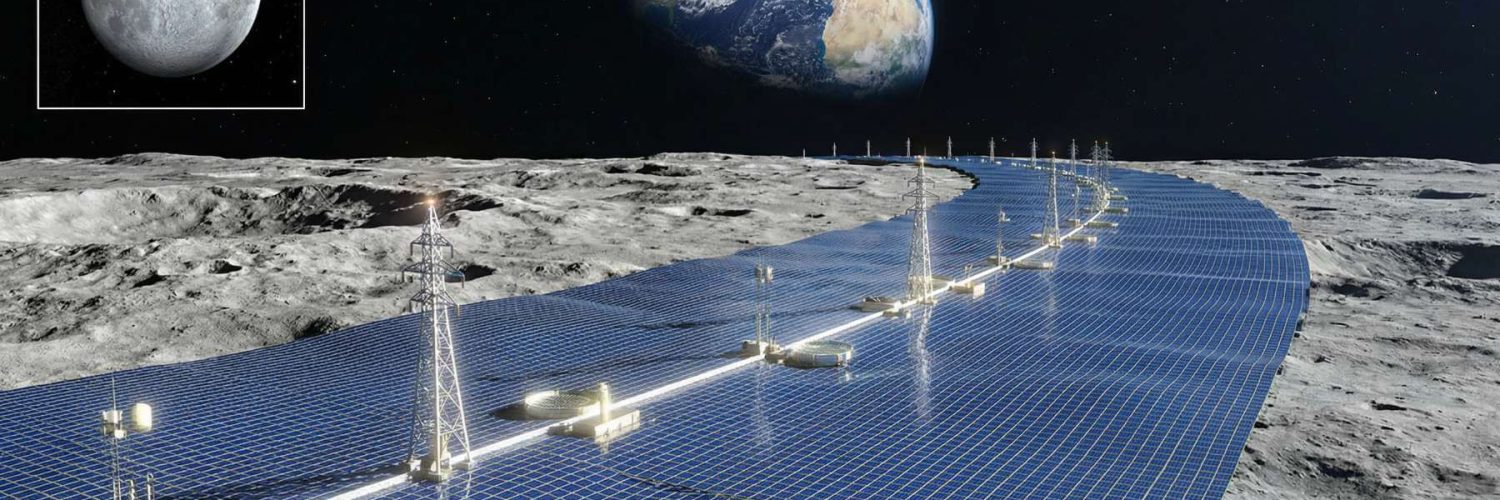
The general contractor and construction firm Shimizu Corporation wants to capture solar power on the moon, convert and transmit this to Earth to supply humanity’s energy needs. The 222-year-old firm plans to achieve this using an ambitious technology that it calls the Luna Ring.
The Luna Ring project aims to generate and transmit solar power to Earth by installing a group of solar power cells up to 250 miles wide around 6,800 miles of the lunar equator.
Shimizu Corporation’s Tetsuji Yoshida introduced the idea in 2010, but it was not until a major catastrophic event hit Japan that it gained traction.
In March 2011, the Tōhoku earthquake and tsunami destroyed the Fukushima Daiichi Nuclear Power Plant, causing what the UN Scientific Committee on the Effects of Atomic Radiation called the worst nuclear incident since the Chernobyl disaster.
At the time, Japan heavily relied on nuclear power which generated nearly 30% of the country’s energy supply, but the nuclear accident was linked to several deaths and injuries from cancer, leukemia and radiation burns.
Amid safety concerns, public opposition against atomic energy hardened and alternative forms of energy to power the country were sought.
Shimizu Corporation considered the moon as a prime location for sourcing solar energy because it virtually has no atmosphere. This means that bad weather and clouds will not disrupt the sun’s rays from reaching the solar panels.
Generating Power on the Moon
If the speculative engineering project pushes through, the Luna Ring would be capable of supplying Earth with significant amounts of power since a space-based system with a continuous supply of sunlight is capable of generating double the power generated on Earth in the same 24-hour period.
According to Yoshida, solar panels on Earth can only generate up to one-twentieth of the energy produced in space.
“In space, there is constant light hitting the solar panels,” he told ABC News in 2011. “When all the energy created from those panels reaches Earth, there will be no need to produce energy from coal, oil, or biomass.”
The Luna Ring’s solar cells will convert light from the sun that hits the lunar equator into electricity. This electricity gets transmitted through a power cable to the side of the moon that constantly faces the Earth. There, the electricity will again be converted into microwave power and laser power that an antenna spanning around 12 miles in diameter will transmit to a power reception rectenna on Earth. The process will use a terrestrial wireless beacon to ensure accurate transmission.
A conversion base will then convert the microwave and laser power when these reach the Earth. The energy will eventually be distributed to a power grid or converted into hydrogen for fuel and energy storage.
Shimizu Corporation said that the project is capable of supplying the world’s needed energy by 2030, which the International Energy Agency (IEA) World Energy Outlook 2008 forecasted to reach 17 billion tonnes of oil equivalent (TOE).
“There is a shift occurring from the existing paradigm of conservation of the limited resources on Earth to the concept of producing nearly limitless clean energy, and freely using the abundance of clean energy. The LUNA RING for lunar solar power generation embodies that concept. It marries an original idea to research and development on space technology,” the company said.
Robots and Lunar Resources
Shimizu said that it can build a lunar power plant using resources available on the moon and the heat from the sun. The company said that the lunar sand can be used to produce ceramics, glass, oxygen, concrete, solar cells and even water.
“The sand on the moon is an oxide compound, so it would be possible to produce oxygen and water if hydrogen were brought from the Earth. Moreover, we could produce cement by mixing water with sand and gravel to produce concrete. It would also be possible to use the heat from the sun to produce blocks and glass fiber,” the company said.
Shimizu is eyeing to begin building the lunar power plant by 2035 and said that robots will play a lead role in the construction. The robots will be operated by remote control from Earth to enable round-the-clock operation.
“All we are doing is using existing resources. We have sunlight, we have solar panels, and we already have microwaves and laser beams,” Yoshida said. “If we can continue to do the research, we think there’s a huge chance this could become reality.”