
 The Starset Society
by: Ambur Masen
According to the UN, nearly two-thirds of the global population experience severe water scarcity for at least one month per year. This issue is expected to get worse with time due to increasing demand and decreasing availability. By 2050, they believe that three out of four people worldwide could be impacted by drought. This may seem like a strange prediction, considering that Earth is known as ‘The Water Planet’. However, the majority of the water here cannot be readily used due to its high salt content.
Only ‘fresh water’, defined by many international organizations as having less than 1% salt, can be used for human consumption and many industrial or agricultural processes.
Of the water on Earth, only about 2.5% of it is considered to be ‘fresh’. The rest of the water is ‘salt water’, or mineralized water, that cannot be directly used for much due to the impurities it contains.
Moreover, only about 1% of all fresh water is easily accessible for human use in the form of surface water, like in freshwater lakes and rivers. Much of the fresh water on Earth is frozen in glaciers and ice caps, or it is trapped deep underground—and getting to these sources of fresh water can be tricky, time-consuming, and costly.
On top of that, climate change is shifting the distribution of available surface water, which can lead to widespread drought and other water-related complications, like famine. As such, organizations around the world have been working towards finding solutions for this impending water crisis.
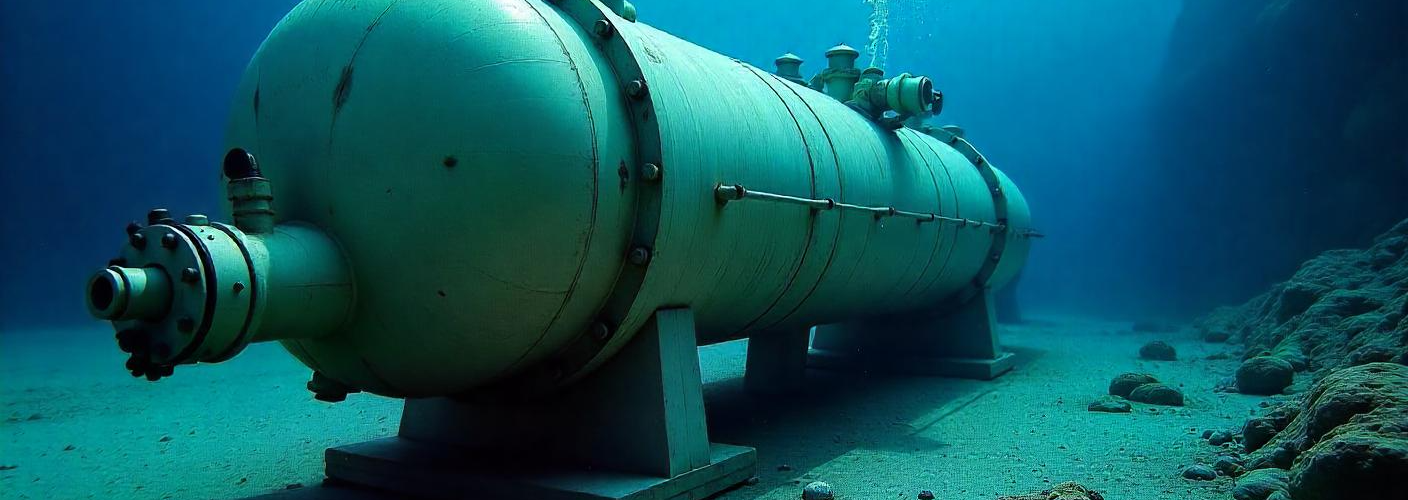
One example is Flocean, a Norwegian company that is currently in the process of opening the world’s first subsea desalination plant with the aim of providing a scalable and environmentally friendly path to global freshwater access.
What is Desalination?
Desalination is the process by which mineralized water (salt water) is turned into water that can be readily used and consumed by humans. There are several methods and technologies used to accomplish this, but at the end of the day, they’re all doing the same thing: separating salt molecules from water molecules, creating fresh water and waste products.
Through desalination, it is possible for us to repurpose some of the ocean (which comprises 97% of all the water on Earth) into a freshwater source that can be used for a variety of purposes, including for drinking water. Imagine taking a sip of the ocean—because in a way, that’s what you may be able to do someday soon.
This all might sound a little like science fiction, but even ancient civilizations found methods for using desalination to create a source of fresh water (think rudimentary sediment-based water filters and distillation, but enough for an entire city at once). Today, however, desalination has been widely considered to be too costly and environmentally unfriendly to be a realistic solution for the impending water crisis, even if it can potentially supplement our stressed water cycle and deter some related environmental damage.
Common Desalination Methods
Of the desalination plants that do exist today, some still utilize distillation as their primary method for creating fresh water. However, membrane technology has become an increasingly more popular desalination solution, especially over the last few decades.
Distillation-Based Desalination
Distillation involves heating water to induce evaporation, collecting the steam, cooling the steam, and then condensing the cooled steam into fresh water. In the process, dissolved salts and other impurities are left behind. However, heating the water enough to induce evaporation requires a huge amount of energy, and not all distillation-based desalination plants are using sustainable energy sources like solar or nuclear power, which means many distillation plants can be expensive and damaging to operate.
Membrane-Based Desalination
Electrodialysis and reverse osmosis are two types of membrane technologies used for desalination.
In electrodialysis, special ion-exchange membranes are used to separate the saltwater molecules into different ions based on charge. An electric current is applied as the salt water is sent through these membranes, which forces the salt ions to separate from the water ions. In doing so, this creates two streams of water—one that contains the dissolved salts, and one that is much less saline. This method is not yet commonly used for desalination plants, but that may change.
Instead, most desalination plants today use reverse osmosis, including Flocean’s upcoming subsea plant.
Reverse osmosis (RO) uses pressure as the catalyst for desalination instead of electricity. In RO, the mineralized water is forced through a semi-permeable membrane with holes just large enough for the water molecules to fit through, and along the way, dissolved salts and other impurities are filtered out.
However, much like with distillation, it can take a lot of energy to use reverse osmosis for desalination, as the water must be under tremendous pressure for RO to work. Also, the waste left behind ends up condensed into a toxic brine that can be complicated to dispose of without harm.
While the brine itself can contain valuable minerals, they aren’t likely worth enough to offset the costs of operating the plant, and the toxic remnants of the brine after their extraction can still be complicated to get rid of safely.
So Why Subsea Desalination?
By utilizing the natural pressure that exists roughly 500 meters deep in the sea, Flocean’s new desalination plant, dubbed ‘Flocean One’, is able to reduce the high energy costs traditionally required to produce the amount of pressure needed for reverse osmosis to work, which solves a major roadblock for a more widespread adaptation of desalination as a solution for the impending water crisis.
For proof-of-concept, Flocean has been operating a test site dubbed ‘Flocean Zero’ for over a year with major success. As it turns out, their subsea desalination concept only uses about half as much energy as land-based RO desalination plants. It also does not produce the same toxic discharge, which solves some environmental concerns.
With the results in hand, they were ready to deploy Flocean One. Though, getting to this point posed a bit of a challenge, according to a company press release: “Subsea desalination demands a fundamentally different engineering approach than traditional land-based desalination plants—integrating high-pressure fluid dynamics, advanced subsea robotics, marine-grade materials, and systems designed to operate autonomously for long durations in extreme environments.”
Despite these technological complexities, they felt up to the challenge, stating that “Flocean is one of the few teams in the world qualified to do this work. Our engineering foundation comes from deep experience in offshore energy, subsea robotics, and modular marine systems—skills traditionally reserved for oil and gas but now redirected toward planetary water resilience.”
As of April 8, 2026, Flocean One was shipped out to its new home in Mongstad, an industrial complex on Norway’s west coast.
It will soon start to produce one million liters of fresh water every day, which is the same as about a day’s worth of usable drinking water for nearly 260,000 people—created from the ocean, by the ocean.
Read more about the project here.