 The Starset Society
By: Rhodilee Jean Dolor
Astronomers have made a remarkable discovery: two bodies in the Solar System appear to host a molecule that the scientific community has not yet seen and identified before.
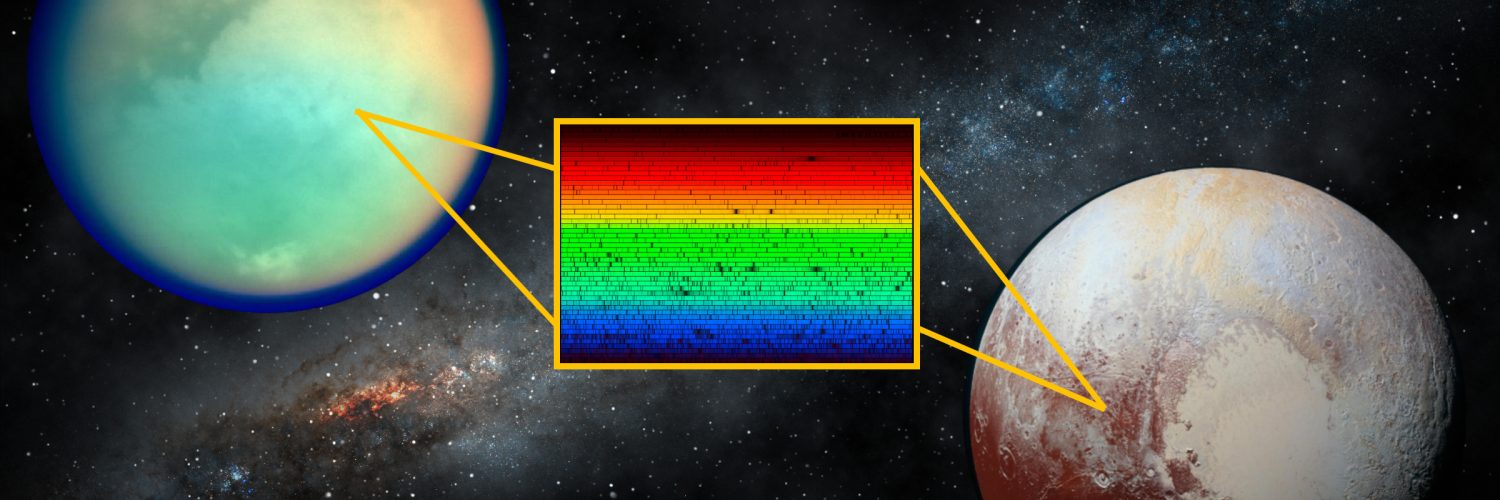
In a new study, Paris Observatory planetary scientist Bruno Bézard and colleagues reported that the instruments on the James Webb Space Telescope (JWST) detected a mysterious spectral signature on the surface of both the dwarf planet Pluto and Saturn’s largest moon, Titan.
The James Webb Space Telescope was launched on Christmas day in 2021 to conduct infrared astronomy. The telescope—the largest in space, is equipped with high-resolution and high-sensitivity instruments making it capable of collecting information from objects that are too distant and faint for the Hubble Space Telescope to observe.
In their research published online in the journal Astronomy & Astrophysics on July 23, Bézard and colleagues said that the Near Infrared Spectrograph (NIRSpec) and Mid Infrared Instrument (MIRI) onboard the JWST detected a unique phenomenon that possibly indicates the presence of an unknown compound or family of compounds on both Pluto and Titan.
Unknown Object
Bézard first spotted the mysterious spectral signature while studying the data that the JWST collected in November 2022 while observing infrared light leaking through the thick haze surrounding Titan.
Molecules leave a unique spectral fingerprint that can be associated with particular substances in space, including simple water ice to complex molecules, so researchers use spectroscopy to identify compounds based on the wavelengths of light that they absorb.
The technique is particularly useful when studying extraterrestrial worlds cloaked by opaque atmosphere such as the Titan.
Bézard scoured through datasets and literature to determine what was absorbing light at the observed wavelength of 5.113 μm on Titan. He did not find a matching molecule suggesting that scientists have not yet identified the mysterious object.
“It’s rather mysterious,” Bézard told Space.com. “We cannot say what it is.”
Still, Bézard considered the idea that another world with a similar atmospheric chemistry could provide an answer. He worked with Paris Observatory scientist Emmanuel Lellouch, who led a JWST program that observed Pluto in May 2023. They eventually found that the dwarf planet has the same spectral signature.
“I asked him, ‘Do you also have a signature [on Pluto] at this exact wavelength?'” Bézard said. “So we looked, and we found that it is present there.”
The researchers also found that the mysterious spectral signature, which appeared to originate from the surface of the two bodies, is about three times wider on Pluto than on Titan.
“We report the detection of an unidentified absorption feature in the JWST spectra of Titan’s trailing and leading sides and of Pluto. This absorption is centered at 5.113 μm (1956 cm−1) and very likely originates from the surface of both bodies,” the researchers wrote in their study.
“Its width is about three times larger on Pluto than on Titan’s trailing side. On Titan, it is possibly narrower on the leading hemisphere than on the trailing hemisphere.”
Potential Candidates
The researchers still do not know what is behind the absorption of light at the wavelength of 5.113 μm but they have some ideas.
They said that the mysterious molecule is not likely a biosignature, but possibly belongs to a family of hydrocarbons known as allenes, the only organic compounds known to exhibit strong absorption bands within the same infrared range as the mysterious signal.
Bézard and colleagues also considered that it could be a known molecule whose spectral signature was altered after mixing with other planetary ices.
“We searched the literature for possible simple ice and organic candidates and find that only a few of them are plausible: the group of allenes and, if mixed with other species, benzene, ketene, or less likely, acetylene (on Titan). The difference in the width of the feature between the two bodies is most likely due to the physical state of the unknown compound at the molecular scale.”
Methane and Ethane in the Atmosphere
The discovery that Pluto and Titan harbor the same unknown molecule is surprising because of the stark difference between the two worlds.
Titan is surrounded by a thick atmosphere. Its surface features vast stretches of sand dunes as well as rivers, lakes and seas composed of liquid methane and ethane.
Pluto, on one hand, is completely frozen on the surface. It has mountains, valleys, plains, and craters made of frozen water ice, nitrogen ice and methane ice. Unlike Titan, Pluto has an extremely thin atmosphere.
Despite the differences, the two worlds both have atmospheres that are composed mostly of nitrogen and methane. The researchers think that the unknown substance formed in the atmosphere through photochemical reactions and then snowed down onto the surface.
Titan and Pluto
Pluto was once considered the Solar System’s ninth planet but the International Astronomical Union (IAU) reclassified it as a dwarf planet in 2006 following the discovery of similar worlds in the Kuiper Belt, the disc-like zone beyond the orbit of Neptune that is populated by thousands of miniature icy worlds.
A dwarf planet is an object revolving around the sun that can pull itself into a nearly round shape but is not big enough for its gravity to clear debris on its orbit. Pluto lies in the Trans-Neptunian region where other objects might cross its orbital path.
Meanwhile, Titan is the only known moon with a thick atmosphere. It is also the only place besides our home planet to have liquids on its surface.
The discovery by NASA’s Cassini mission to Saturn that Titan is hiding an underground ocean of liquid water has raised interest in the moon. With an ocean of liquid water, it is one of the few worlds in the Solar System that potentially host habitable environments that could support life.
To date,however, scientists have yet to find evidence of life on this Earth-like world. NASA’s upcoming Dragonfly mission will explore various locations on Titan to investigate the habitability of Saturn’s largest moon.