 The Starset Society
By: Rhodilee Jean Dolor
In 1921, German psychologist Wolfgang Köhler published his book that detailed his findings about animal intelligence. Intelligenzprüfungen an Menschenaffen (The Mentality of Apes) is based on his study involving bananas, boxes and chimpanzees.
In what later became a classic experiment in the field of comparative psychology, Köhler hung a banana out of reach of a group of chimpanzees and scattered boxes and crates on the floor. The primates stacked up the boxes to grab the fruit demonstrating that they do not just rely on learning by trial and error but have insight—the ability to understand cause and effect without prior experience.
The study would have a profound impact on how humans regard intelligence in the natural world. More than a century after Köhler conducted his experiment, researchers have also documented impressive cognitive abilities in other species: whales communicate with each other using clicks and sounds; African gray parrots can repeat words and phrases and crows use tools to forage for food.
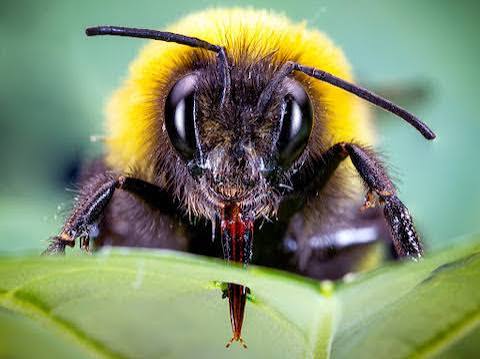
Experiments now show that the small-bodied bumblebee also possesses complex learning ability like these large animals. Researchers in Finland found that these pollinators can use tools and solve problems to access a goal.
Blue Artificial Flower and Ball Experiment
In a new study published in the journal Science on June 4, Olli Loukola, a behavioural ecologist at the University of Oulu in Finland, and colleagues conducted a version of Köhler’s experiment to find out if bees can also accomplish tasks that they have not encountered before.
The researchers trained the bees to associate a blue artificial flower with a sweet treat. In the experiment, they placed the flower in the ceiling of a petri dish-style chamber that only allowed the insects to walk but not fly.
The flower in the ceiling was too high for the bees to reach but the researchers also introduced a ball into the chamber. During the experiment, the bees rolled the ball and climbed on top of it like a stepstool to reach the flower, demonstrating a behaviour that the insects were not trained to perform.
In a more complex setting, which was designed to test the insects’ insight, Loukola and colleagues allowed the bees to explore a left and right chamber, one of which featured the artificial flower.
The researchers then illuminated the chamber with red light so the bees could not see the flower then they introduced the ball. The bees needed to recall the location of the flower and place the ball beneath it to complete the task. Of the 30 insects, 23 were successful.
The result in the last setup addressed the possibility that the bees were able to position the ball in the right spot because the insects simply enjoyed the sensation of rolling a ball and were drawn towards the blue-colored reward.
“We investigated whether bumble bees (Bombus terrestris) could solve a novel object manipulation task spontaneously,” the researchers wrote in their study. “In control experiments in which the flower was out of sight when ball movement began and remained hidden during transport, bees still succeeded in the task.”
The experiment suggests that bumblebeebees can use tools. They can manipulate objects to achieve their goals even without prior exposure to the problem.
“This is essentially an insect version of the classic ‘box-and-banana’ problem,” Loukola said in a statement. “The animal must realize that an object can be repositioned and then used as a tool to reach an otherwise inaccessible goal. What stands out about the result is that this kind of spontaneous problem-solving is now demonstrated in an insect.”
What sets the experiment apart from those in other studies is that Loukola and colleagues did not train the bees to complete the task.
“In many previous studies of insight-like problem-solving, the animals have had extensive experience with objects, test environments, or other problem-solving tasks. Here, the bees had never been trained to use the ball to reach the flower, and they had no previous experience with this kind of solution,” Loukola said. “We also designed the experiments to rule out simpler explanations such as accidental success, play behaviour, trial-and-error learning, or direct visual guidance.
Small Body, Big Brains
Bees are tiny insects with a brain roughly the size of a sesame seed. The researchers said that problem-solving using novel solutions without training is a hallmark of cognitive flexibility and the bees, despite their size, demonstrated this in the experiments.
“These results suggest that these were goal-directed actions rather than reinforcement-based associations driven by perceptual feedback. Our findings provide evidence that bumble bees can exhibit spontaneous problem-solving, challenging the notion that such advanced cognitive abilities are exclusive to large-brained vertebrates.”
Lars Chittka, author of The Mind of a Bee and a behavioural ecologist at Queen Mary University of London, said in an interview with The Guardian that the study is proof that high intelligence in the animal kingdom does not necessarily correlate to size.
“There’s a general perception that intelligent behaviour requires big brains because we are big-brained and relatively intelligent among animals,” Chittka said. “Bees are a model of how much intelligence you can squeeze into a small nervous system.”
Cognitive Ability Aids Bees’ Role in Pollination
The study adds to a growing amount of evidence suggesting that bees have sophisticated cognitive abilities. Recent experiments have also shown that these creatures can learn from each other and perform basic math.
Researchers think that the bees’ flexibility to learn helps them interact with flowers and cope up with the challenges of changing environments.
Bees are main pollinators of plants and thus play a crucial role in global food security but warming temperatures, diseases and shifting landscapes threaten these creatures.
“Today they might find flowers from here, but tomorrow those flowers are not blooming anymore,” Loukola said, according to NPR. “If the workers can flexibly find new ways to get food for the colony, that’s the skill that they need to have.”