 The Starset Society
By: Rhodilee Jean Dolor
Findings of a new study suggest that the predecessor of one of the most fearsome predators to ever roam the Earth crossed an ancient land bridge millions of years ago to reach what is now North America.
Migration from Asia
In an earlier research, Steve Brusatte, from the University of Edinburgh, and Thomas Carr, from Carthage College, analyzed 28 different tyrannosaur species and constructed a family tree with estimates on when and where each of the species lived.
The analysis showed that the T.rex was not a North American native and was likely an invasive species from Asia. The researchers noted that the dinosaur appears to be more closely related to the Tarbosaurus, a large meat eater that lived in Asia, than with the top predators in North America such as the Daspletosaurus.
“Our phylogenies illustrate that the body plan of the colossal species evolved piecemeal, imply no clear division between northern and southern species in western North America as had been argued and suggest that T. rex may have been an Asian migrant to North America,” Brusatte and Carr wrote in their paper, which was featured in the journal Scientific Reports in February 2016.
Researchers of a new study now reveal how the T.rex came to exist in North America. Cassius Morrison, a doctoral student of paleontology at University College London (UCL), and colleagues investigated how the ancestors of the prehistoric carnivore evolved around the globe.
For their study published in the journal Royal Society Open Science on May 7, the researchers used mathematical models that incorporated data from fossil records, T. rex family tree as well as the geography and climate conditions at the time to trace the evolution and movement of the tyrannosaurs.
Morris and colleagues said that the geographic origins of the T.rex is a subject of debate among paleontologists. Some think that the predator’s progenitors came from Asia while others argue that they were from North America.
The models suggest that while the T.rex evolved in North America, its direct ancestor originated from Asia.
“T. rex evolved from direct Asian ancestors. This hypothesized descendance is based on the phylogenetic placement of T. rex in a clade with other Asian tyrannosaurs,” the researchers wrote in their study.
Bering Land Bridge
According to Morrison and his team, the predecessor of the T.rex likely arrived in North America from Asia after crossing a land bridge that connected the two continents around 70 million years ago.
“Our modelling suggests the ‘grandparents’ of T. rex likely came to North America from Asia, crossing the Bering Strait between what is now Siberia and Alaska,” Morrison said. “Dozens of T. rex fossils have been unearthed in North America but our findings indicate that the fossils of T. rex’s direct ancestor may lie undiscovered still in Asia.”
Today, the Bering Strait connects the Pacific and Arctic Oceans but during the last Ice Age, the lower global sea level exposed a stretch of land in the area— the Bering Land Bridge, or Beringia, that linked Asia and North America.
The land bridge is now mostly submerged due to sea level rise, but scientists believe that it played a crucial role in the migration of animals and humans between continents.
Laramidia
Morrison’s team concluded that the T. rex evolved in North America, specifically in Laramidia, an island continent that existed during the Late Cretaceous period when a shallow sea divided North America into two land masses: the Appalachia in the east and Laramidia in the west.
“The ancestor of Tyrannosaurus–Tarbosaurus clade was present in both Asia and Laramidia, suggesting that the direct ancestor of Tyrannosaurus dispersed into Laramidia from Asia,” they wrote in their study. “[T]he genus Tyrannosaurus originated in Laramidia from an ancestrally Asian taxon that emigrated to North America during the Late Campanian—Early Maastrichtian.”
Laramidia was the home of a plethora of dinosaurs including tyrannosaurs, horned dinosaurs (ceratopsians), duck-billed dinosaurs (hadrosaurs) and raptors (dromaeosaurs) in prehistoric times.
Most T.rex fossils were discovered in Montana and South Dakota in the US and Alberta in Canada, which used to be part of Laramidia that stretched from modern-day Alaska to Mexico.
Dinosaur King
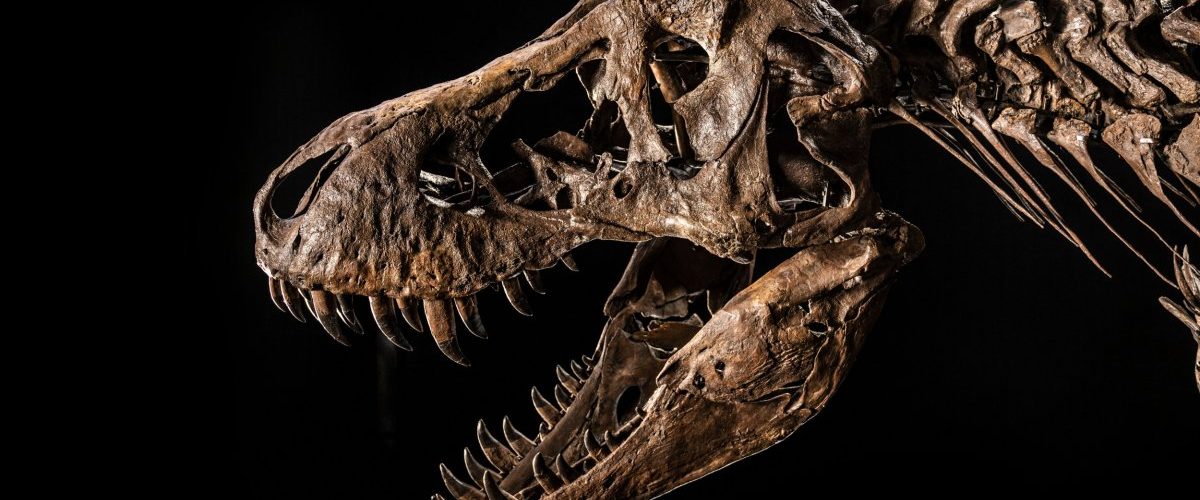
The Tyrannosaurus rex is one of the largest carnivorous dinosaurs. This apex predator, which hunted Laramidian species such as Triceratops, Edmontosaurus and Ankylosaurus, lived between 67 million and 66 million years ago at the end of the Cretaceous period.
Studies suggest that the average weight of the T.rex is between 15,266 and 23,037 pounds (6,925 and 10,450 kilograms) albeit a research presented at the Society of Vertebrate Paleontology’s (SVP) annual meeting in 2022 suggests that some may have weighed up to 33,000 pounds (15,000 kilograms).
Sue, a 90% complete T.rex fossil that is displayed at the Field Museum of Natural History in Chicago, Illinois, is estimated to be about 41 feet (12 meters) long and about 12.5 feet (3.8 meters) tall at the hips.
According to the new study, tyrannosaurs grew to gigantic sizes as the climate cooled following a prehistoric hot spell known as the Cretaceous Thermal Maximum that peaked around 92 million years ago. Their rapid growth occurred after another group of giant meat eaters known as carcharodontosaurids went extinct.
“Our findings have shined a light on how the largest tyrannosaurs appeared in North and South America during the Cretaceous and how and why they grew so large by the end of the age of dinosaurs,” said study co-author Charlie Scherer, an MSci Earth Sciences graduate and founder of UCL’s Palaeontology Society.
“They likely grew to such gigantic sizes to replace the equally giant carcharodontosaurid theropods that went extinct about 90 million years ago. This extinction likely removed the ecological barrier that prevented tyrannosaurs from growing to such sizes.”
photo