 The Starset Society
by: Estefania Gatton
As the Horizon Vanishes
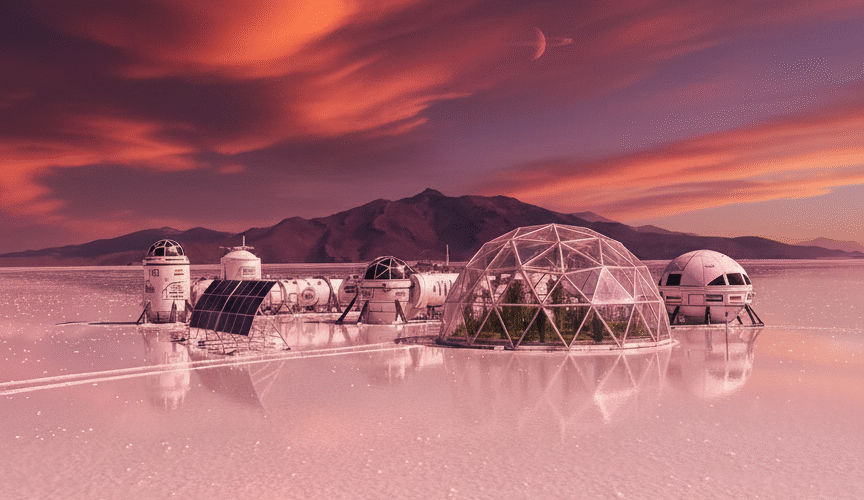
The blinding white was not a blank canvas. It was a universe of fine, crystalline hexagons, a puzzle of salt stretching to a horizon that no longer existed, swallowed by a sky the exact shade of bleached bone. Commander Maribel called this the “Great Unraveling”, when the moment the landscape’s vastness dismantled the mental armor of even the most hardened scientists. For Joseph, the engineer, the unraveling had begun weeks ago, each day adding another layer of stress to the constant hum of the habitat’s life support systems.
He stood hunched over the rover, his gloved hands meticulously wiping away salt dust that had worked its way into the smallest gears. The rust-colored streaks on the white chassis were a mark of the enemy: a harsh, corrosive nemesis that mimicked the Martian saline formation’s surface with unnerving accuracy. The rover, a marvel of terrestrial engineering, was failing its test on Route 3, the most challenging of the trial routes of the complex, again.
“It’s not responding,” Joseph said, his voice flat through the comms. “The central motor is gone. The salt ate through the copper winding.”
From inside the habitat, Maribel’s voice crackled with her usual good humor, a stark contrast to the sterile environment. “Keep at it. Thinks as we’re not on Earth anymore. This is a one-way trip, remember? You’ve got to learn to build something that lasts… for a long time.”
A little farther out, Nicole was inspecting a core sample, she was vibing at the rhythm of the lofi-music she was listening to. She’d been awake for forty-eight hours straight, powered by ambition and the terror of failure. For her, the salt flat was like a puzzle, a geological mirror of Mars itself, and she couldn’t rest until she had solved its secrets. Her voice, sharp and energetic, cut across the comms. “You’re looking at it the wrong way, Joseph. It’s not a failure. It’s a data point. What material would have worked?”.
He had no answer at that moment. The feeling of helplessness was a constant companion in the isolation. He was a tech specialist in a place where technology was failing, a human solution in an environment designed for no human, maybe not life itself from the perspective of Joseph. He sighed and leaned against the rover’s wheel, the cold seeping through his suit. It was then, in the surreal quiet, that he saw it. A dark shape, no bigger than a tennis ball, scurrying across the salt pan from one small island of land to another. It was an animal, its fur matted, moving with a speed that defied the hostile landscape. He couldn’t believe his eyes.
He keyed his comms again, bypassing the general channel. “Kantuta, are your biological sensors picking anything up?”
The voice of Kantuta was a soothing calm. “Depends, Joseph. What are you looking for?”
“Movement,” he said, his voice barely a whisper. “A small animal maybe?. I swear I just saw something!. How could something like that survive out here?”
Kantuta’s reply was soft and wise in tone, she knew this place before. “Ah. It is probably a vizcacha, though we can’t rule out other endemic fauna. Who knows… There are not many studies on the biodiversity of this environment, so it could even be an undocumented species. How they survive without the aid of technological life support is the most interesting question of all, isn’t it? I should request a project for researching these interesting organisms and their hidden secrets of adaptation.”
“A perfect biomachine, sculpted only by time,” Nicole noted. “It’s a reminder, Joseph: success on Mars won’t be immediate. We can’t compress a million years of natural selection into a prototype. We must give the data, and ourselves, time to adapt.”
Joseph remained silent; only the audible intake and exhalation of his breath registered over the comms system.
Kantuta: “Right, but mission clocks show it’s nearly time for breakfast and our scheduled review. I’m finally defrosting that apple cinnamon “pie”. We’ve earned the caloric reward.”
“Ugh, the constant shift to nighttime operations is really scrambling my clock. I genuinely perceived this as the evening mealtime, not the start of the next work cycle.”- complained Maribel.
Joseph remained motionless in the silence. He was so stunned that the mention of breakfast seemed trivial. Kantuta’s words had introduced a new quality to his perception of the landscape—no longer one of sterile isolation, but of profound, living mystery.
Here they were, a crew of scientists representing humanity’s best efforts, struggling to keep a multi-million-dollar rover from being undone by a handful of abrasive salt dust. And there, somewhere in the distance, was a small, furry creature: a survivor, a natural rover perfected by deep time, a native thriving in a place they were desperately attempting to conquer.
It was a deeply disturbing thought. It settled in the cold, still air, a feeling of being fundamentally out of place in a world not built for their specific, technologically-dependent form of life. Joseph looked at the disabled rover, its complex mechanics defeated by simple chlorides; then, his gaze swept across the vast, empty expanse toward the now pink-colored sunrise. He wondered what other life had been living here, thriving in silence, or perhaps even existed among the silent stars of the night, all along.
The Mars Analog
While the challenges faced by this fictional crew may seem like a distant struggle, the underlying scientific principles and technological hurdles are very real. Many organizations are actively using extreme environments on Earth as “analog” sites to prepare for a manned mission to Mars (1,2). The Uyuni Salt Flat (3) provides a unique setting for these studies, offering crucial insights into the human element and the technological demands of a one-way trip, as an example the Artemis Missions (15), serving as a vital proving ground for humanity’s journey to another world.
The Uyuni Salt Flat’s Unique Suitability
The Uyuni Salt Flat (4) stands out as a unique and invaluable proving ground for humanity’s journey to Mars. Spanning over 10,000 square kilometers, its extreme flatness and barren, white expanse are an uncanny match for the Martian plains, offering a perfect terrain for testing rovers and exploration vehicles. But its value goes far beyond mere aesthetics. The high altitude and low humidity of the region could be a close terrestrial analog to Mars’s thin atmosphere (16), providing a realistic environment to test habitat pressure systems and life support equipment. Moreover, the vast, uninterrupted landscape offers a level of isolation that is critical for studying the human psychological response to long-duration confinement. The salt deposits themselves present a perfect opportunity to practice geological sampling and research into extremophile organisms (5) that could hold clues to finding life beyond Earth.
Connecting to Real-World Technologies
The challenges faced by the crew in the fictional narrative are not mere science fiction; they are a direct reflection of the real-world problems humanity must solve before reaching Mars. A host of international organizations are simultaneously working on a range of technologies to make such a journey possible, such as NASA, SpaceX, ESA, DLR, Roscosmos, The Mars Society, Blue Marble Space, and even regional groups as the Bolivian Network of Planetary Sciences and Space Exploration. The primary focus of these real-world efforts mirrors the story’s core conflicts: the development of durable hardware, sustainable life support systems, and the study of human adaptability in the face of immense environmental stress.
Rover and Hardware Development: The corrosive nature of salt deposits is a real-world concern (6). Salt deposits on Mars (7), confirmed by orbiters like the Mars Odyssey (8) and Reconnaissance Orbiter (9), necessitate the development of highly durable rovers. Analog missions allow engineers to test new alloys and protective coatings in environments that replicate these conditions, ensuring that future Martian rovers won’t be undone by the abrasive, salty dust.
Sustainable Life Support and Food: The survival of the vizcacha (10) in the story is a symbol of a crucial real-world problem: how to create a sustainable colony where resources are scarce. The few water sources in Uyuni are highly saline, mirroring the challenge of finding and purifying water on Mars. This environment provides an ideal testing ground for advanced water filtration systems. Furthermore, the search for native, extremophile life in places like Uyuni is not just for biological curiosity; it’s a search for survival. Animals like the vizcacha, Andean geese, and flamingos have adapted to this hyper-saline environment, providing clues for discovering and developing nutritious, salt-resistant crops or plants, making long-term habitation possible.
Psychological Resilience: The isolation experienced by the fictional crew is a central focus of analog missions like the HI-SEAS experiment (11). Humans have evolved to be deeply connected with others (12), an analog mission in Uyuni Salt Flat will allow researchers to study the effects of prolonged confinement and isolation on crew mental health. Moreover, studies have shown a direct link between mental well-being and exposure to natural elements like the color green (13, 14). The stark, barren environment of the salt flat is an excellent psychological analog for Mars precisely because it lacks these components. By training in such an environment, researchers can study the effects of prolonged exposure to this kind of environment on crew mental health. This research helps in selecting the right crew members and developing protocols for maintaining team cohesion, ensuring that the human spirit is as resilient as the technology supporting it.
Conclusion
The Uyuni Salt Flat mission is about more than just a training ground for a long journey. The lessons learned in this extreme environment, both the triumphs and the failures, carry profound implications for humanity’s future, on both Mars and Earth.
The core of this mission is not about overcoming technology; it is about strengthening the human spirit. The psychological resilience tested in the Uyuni salt flat is paramount. While our technological ingenuity can solve problems of hardware, it cannot fix the loneliness and isolation of a one-way trip. By understanding how crews maintain cohesion and mental well-being in these harsh, barren landscapes, we can ensure that our first steps on Mars are not just a technological feat, but a sustainable human endeavor.
The mission also showcases how challenges can drive innovation. The same technologies developed to purify hypersaline water for these missions could provide life-saving solutions for communities facing water scarcity on our planet, correlations that have occurred in the past (17). The search for a new, salt-resistant crop, spurred by the need for survival on Mars, could lead to breakthroughs in global food security. The mission to a new world becomes a quest to make our own world better.
Ultimately, the small, thriving creature in the vast expanse of the salt flat symbolizes a powerful truth: resilience is not a matter of size or complexity, but of adaptation. Just as the vizcacha has found a way to survive in this hostile environment, human resourcefulness, coupled with our capacity for collaboration, can enable us to not only survive but also flourish in the most unforgiving corners of the universe. The mission to Mars is not about leaving our problems behind, but about bringing our best solutions with us.
References
1. NASA. Extreme Environment Analogs Assessment Program (EEAAP) https://www.nasa.gov/ochmo-extreme-environment-analogs-assessment-program/
2. NASA. Planeray Analogs. https://science.nasa.gov/solar-system/planetary-analogs/
3. Mapping of chloride deposits on Icaria Planum on Mars, and its possible correlation with the Uyuni salt flat in Bolivia https://ui.adsabs.harvard.edu/abs/2024EPSC…17..483J/abstract
4. Oxford Academy. Topography of the salar de Uyuni, Bolivia from kinematic GPS https://academic.oup.com/gji/article/172/1/31/2081107
5. Science Direct. Microbial diversity of the hypersaline and lithium-rich Salar de Uyuni, Bolivia https://www.sciencedirect.com/science/article/pii/S0944501317301532
6. NIH. Marine Atmospheric Corrosion of Carbon Steel: A Review https://pmc.ncbi.nlm.nih.gov/articles/PMC5506973/
7. JPL. Salts Could Be Important Piece of Martian Organic Puzzle, NASA Scientists Find https://www.jpl.nasa.gov/news/salts-could-be-important-piece-of-martian-organic-puzzle-nasa-scientists-find/
8. NASA. NASA Confirms Evidence That Liquid Water Flows on Today’s Mars https://www.nasa.gov/news-release/nasa-confirms-evidence-that-liquid-water-flows-on-todays-mars/
9. JHUAPL Large-Scale Liquid Water Existed on Mars Much Longer Than Suspected https://www.jhuapl.edu/news/news-releases/220126b-mars-salt-deposits
10. Andean Fauna https://uyunisaltflat.com/andean-fauna
11. HI-SEAS https://www.hi-seas.org/
12. NIH. Social Isolation, and its Effects on Physical and Mental Health https://pmc.ncbi.nlm.nih.gov/articles/PMC10121112/
13. American Psychological Association, Nurtured by nature, Psychological research is advancing our understanding of how time in nature can improve our mental health and sharpen our cognition https://www.apa.org/monitor/2020/04/nurtured-nature
14. NIH. Adaptive Effects of Seeing Green Environment on Psychophysiological Parameters When Walking or Running https://pmc.ncbi.nlm.nih.gov/articles/PMC6379348/
15. NASA. Artemis. https://www.nasa.gov/humans-in-space/artemis/
16. Mars Atmosphere Facts. https://marsed.asu.edu/mep/atmosphere 17. JPL. 20 Inventions We Wouldn’t Have Without Space Travel https://www.jpl.nasa.gov/infographics/20-inventions-we-wouldnt-have-without-space-travel/